
Events
Main Passage: 2 Timothy 3:16
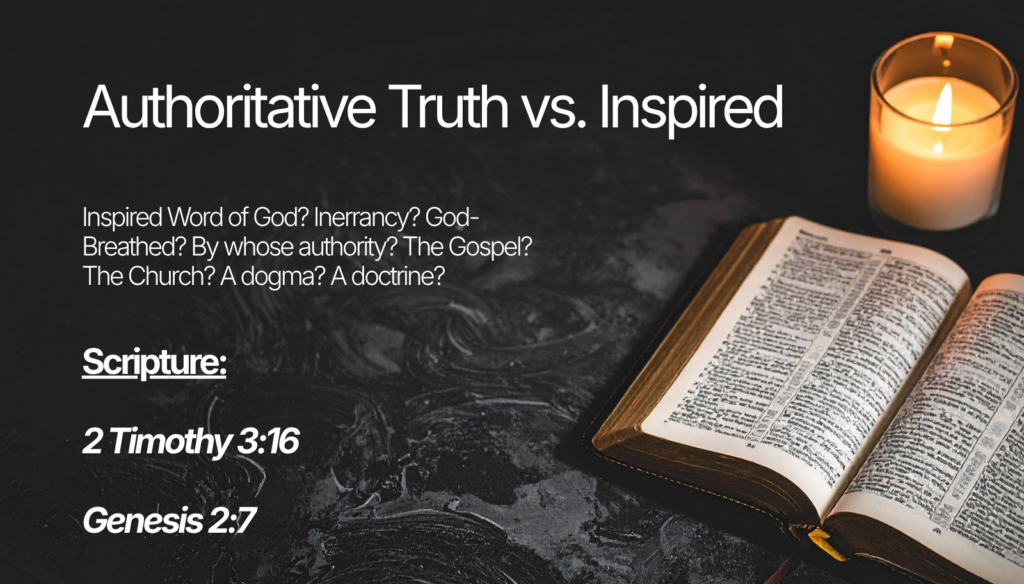
By whose authority? The Gospel? The Church? A dogma? A doctrine?
As you all know, every time I do a study or give a sermon, I take it back to how the original authors and audiences would have understood the text to mean. What time period? What was the location? What was going on socially? Politically? Economically? What influences their culture and belief system? Linguistics? And much more. This is how I read over 90 books last year. That doesn’t count the lectures I sit in on.
I say all this, not to brag, but to give a small idea of how deep and complex our sacred Scriptures are. When we think something is straightforward, believe me when I tell you that you’ve only scratched the surface. Take our passage that we will mainly be focusing on tonight as an example: 2 Timothy 3:16.
“All scripture is inspired by God and is useful for teaching, for reproof, for correction, and for training in righteousness,”
The word I want us to focus on tonight is “inspired.” What does that term mean to you?
In our modern English context, it could be a few things: to be filled with the urge, ability, or creativity to do something great; or to describe something that is of excellent quality. Often it is seen as coming from divine or supernatural influence. But we use that same word when an artist sees a sunset and is “inspired” to paint. To find the answer, we have to look at the original language. Would we equate that same level of divine nature to the painting? What makes them different?
The Koine Greek word that we have translated to English as “inspired” is theopneustia. This original word in its own context did not, in fact, mean “inspired” as most Christians understand it today. Remember, words’ meanings can change over time. We’ve learned in past sermons that “girl” originally referenced any child regardless of their gender. Over time, it has changed to mean a female child. It evolved. If we didn’t know the history or how the original audience understood the word, we would have always thought that “girl” was always defined that way. Nope! Theopneustia is the same way.
The doctrine of “inspiration” is wrapped up in “inerrancy.” These are later theological views. My attempt in this sermon is to untangle them—unravel them—so that we know on what truth and by whose authority we are standing on.
If we look closely at theopneustia, its best and truest translation is “life-giving” or “God-breathing.” It is not “God-breathed” in a passive, stagnant sense. When this word is used, it is always directly associated with the active process of creation by Yahweh. Scripture is the product of God’s breath. It is Yahweh’s active creation. It is His fruit. This doesn’t mean the text itself is an independent entity creating and forming things on its own. No, the power belongs entirely to the Almighty Father. This language directly connects us straight back to the creation account in Genesis 2:7:
“…then the Lord God formed man from the dust of the ground and breathed into his nostrils the breath of life, and the man became a living being.”
Here is the core truth we must grasp: the original authors and the early church audiences did not understand the concept of “inspired Scriptures” the way we do today. Nor did they have a modern, rigid doctrine of technical inerrancy. That’s a mouthful, huh?
To understand why we need to unpack this word, we have to look at what modern “inerrancy” does and does not actually mean.
What it does NOT mean:
Scientific or mathematical precision:
The biblical authors were not writing modern technical textbooks. When they described the sun rising, or rounded a massive number during a census, they were using everyday language of appearance, not lying.
Apply to your physical Bible (or e-Bible):
The doctrine of inerrancy explicitly states that only the original autographs (the original parchment documents written by the authors’ own hands) were perfect. It does not claim that every translation throughout history was flawless.
Ignore human style:
God did not treat the authors like passive robots or typewriters. Each author retained their own vocabulary, personality, and cultural limitations. God or the Holy Spirit did not possess people or grab a quill themselves and go to town.
What inerrancy DOES mean:
Truthfulness in what it intends to affirm:
At its core, the baseline definition is simply that Scripture tells the truth in everything it explicitly intends to teach or command.
So, how did the authors view the authority of sacred text? It was entirely different from our modern concepts:
Covenantal Authority, Not Academic Precision
For the ancient Israelite and the first-century Jew, Scripture was authoritative because it was a covenant document. It was the binding agreement between Yahweh and His people. They didn’t check the text against modern historical or archaeological databases to see if it was “true.” The authority rested on the character of the God who made the promise, not the exact grammatical precision of the scribe who copied the scroll.
Function Over Form
When Paul says Scripture is useful for “teaching, reproof, correction, and training,” he is defining its authority by what it does, not by a philosophical label. Ancient audiences saw Scripture as an active, living instrument. Its authority was proven when it transformed a community, brought conviction, and pointed them to the living God.
The Text as a Mile Marker, Not the Destination
The original authors understood that the words on the page were meant to point to a higher reality. The text was never meant to be an object of worship. The Hebrew prophets wrote down their visions to bind the hearts of the people to Yahweh. The New Testament writers penned letters to point people to the living historical event of the Resurrection.
When we force ancient writers into modern theological debates about technical perfection, we miss their entire point. They weren’t trying to satisfy modern scientific critics; they were trying to testify to the authority of a living God who speaks, acts, and breathes life into His creation.
The definitive truth—the ultimate “God-breathed” reality—is not found in a flawlessly bound leather book, a finalized canon, a strict systematic doctrine, or a political church council. The ultimate truth is found in the Gospel.
Our faith is anchored in the Good News of Yeshua Hamashiach (Jesus Christ), proclaimed by the living, breathing apostles who were eyewitnesses to God’s ancient prophecies coming to pass. In the earliest days of the Church, the supernatural intervention of God was recognized primarily in the prophetic message of the Gospel itself.
The text—the Scriptures—are the beautiful, authoritative witness to the Truth. But the ultimate Truth is a living Person: Yeshua Hamashiach.
Amen.
Further Study
The Invention of Inspired Text by John C. Poirier
The Inspiration and Interpretation of Scripture by Michael Graves
Introducing Christian Doctrine (3rd Edition) by Millard J. Erickson