

Upcoming Events
Please subscribe to our Google calendar!
Sermon
Have you ever worked in a garden? Or with plants? What did you have to do to get things to grow? How do you keep the plants healthy and strong? Pruning? What is its purpose?
“pruning in horticulture, the removal or reduction of parts of a plant, tree, or vine that are not requisite to growth or production…or are injurious to the health or development of the plant.”
-Britannica
Usage Examples:
- Improving yield and quality
- Removing shoots or fruit that are not good for the success of the plant.
- Disease and pest management
- Preventing the spread of infection.
When learning about agriculture for this sermon. I came across the phrase “structural training”. What on earth is that? It is the act of pruning young trees to establish a strong structure which prevents future damage.
- Select the healthiest/strongest stem. This will be the main trunk.
- Select primary branches that will be the tree’s frame work. They must be properly aligned.
- Size management. If one branch gets too big it can cause the trunk to not grow as big and strong. This is done to maintain a strong union.
- There are even temporary structures used to hold up the tree. Think planks or rods. But they are removed as the tree grows stronger. It can now hold itself up.
Take away: Early intervention is key!
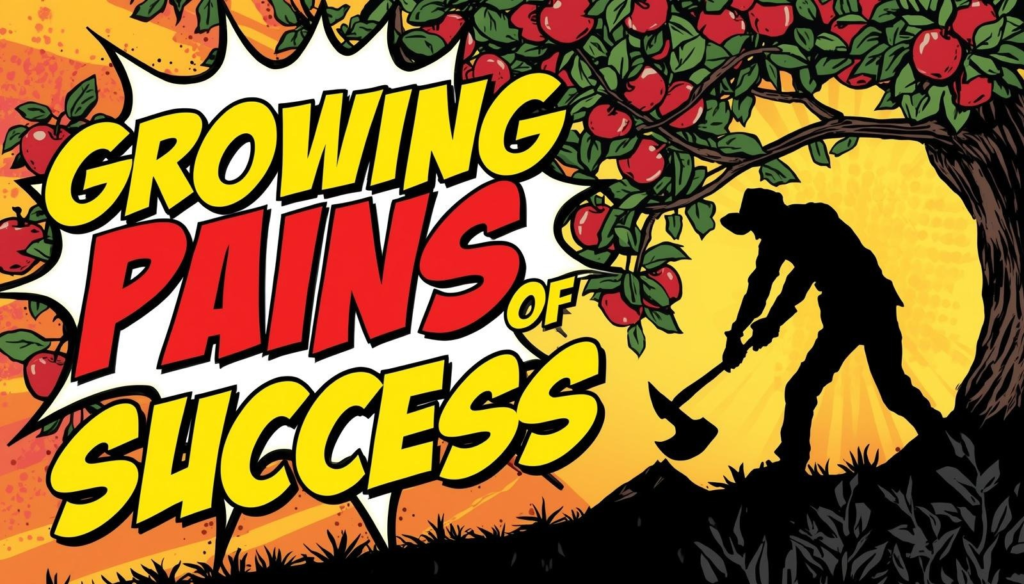
Pruning is hard work. Pruning isn’t fun. Pruning is in some ways painful. Pruning is losing something even if it is for our…I mean…the plant’s own good. It heals over. Grows stronger. Growing pains.
I never thought I’d be preaching about growing trees but the Holy Spirit said “HERE WE ARE!”
“But if some of the branches were broken off, and you, a wild olive shoot, were grafted among the others to share the rich root of the olive tree, do not boast over the branches. If you do boast, remember: you do not support the root, but the root supports you. You will say, “Branches were broken off so that I might be grafted in.” That is true. They were broken off on account of unbelief, but you stand on account of belief. So do not become arrogant, but be afraid. For if God did not spare the natural branches, neither will he spare you. Note then the kindness and the severity of God: severity toward those who have fallen but God’s kindness toward you, if you continue in his kindness; otherwise you also will be cut off. And even those of Israel, if they do not continue in unbelief, will be grafted in, for God has the power to graft them in again. For if you have been cut from what is by nature a wild olive tree and grafted, contrary to nature, into a cultivated olive tree, how much more will these natural branches be grafted back into their own olive tree.”
-Romans 11:17-24
Since we’ve been talking about plants let’s learn about grafting. It’ll make sense. You’ll have a light bulb pop on! What is grafting? Do you know?
Grafting works by physically fusing the living tissues of two different trees (or plants) so they grow as one. During the fusion process a “bridge” of cells is created that fills the gap between the two foreign branches Grafting is needed in some cases because without it, the tree cannot produce quality fruit. For example: Apples. If grafting doesn’t happen then the quality of the fruit cannot be preserved. So, that means if you plant a see from a specific apples such as a Honey Crisp, you aren’t guaranteed a Honey Crisp. Usually it’ll be a crabapple. Small. Sour. By grafting a branch from a known variety to the seed, you guarantee the fruit produced. Without grafting you wouldn’t have the apples we eat in any store or market.
“You will know them by their fruits. Are grapes gathered from thorns or figs from thistles? In the same way, every good tree bears good fruit, but the bad tree bears bad fruit. A good tree cannot bear bad fruit, nor can a bad tree bear good fruit. Every tree that does not bear good fruit will be cut down and thrown into the fire. Thus you will know them by their fruits.”
-Matthew 7:16-20
Fruit is the product of the plant. The tree. If the plant is poorly cultivated. Poorly tended too. Poorly pruned. Poorly supported. Then, it will produce BAD FRUIT. However, if the tree is looked after consistently. If the gardeners watch out for the mission…the trunk…the various branches. If they trim. If they add in new or remove old. Then the fruit can be delicious. Gorgeous. Nutritious. GOOD FRUIT.
Last service we learned of the importance of every member taking part in intercessory praying. Building up a covering for us all so that none fall through the cracks. This sermon’s message is also about requiring all to take part. We are al the gardeners and our church is the tree! the Bible tells us in 1 Corinthians 12:12, “For just as the body is one and has many members, and all the members of the body, though many, are one body, so it is with Christ.” It takes a village. Especially as we grow.
“Growing pains. Sometimes God adds new branches to our tree that are strange and can be heavy at first but over time as we grow with it it can produce something better. Or [God] takes branches that we wanted to hold onto.”
-Chris
Even if it hurts. Cutting away dead, diseased, or unfruitful leaves or branches will help us to produce better fruit. Growing pains.
This message wasn’t about plants it you haven’t guessed. It is about growing in our ministry. As we advance, things will change. It is inevitable. New policies. New faces. Old ones fading away. Existing things adapted to the needs of the whole. But if you as the gardeners stay vigilant. If we keep to the mission. If we do not lean on our own understanding. If we don’t act in our flesh right out the gate. If we adapt. If we trust each other. THEN. And only then. Will we produce GOOD FRUIT.
Amen.
